The Silver Lakes Window Field Guide · Pretoria East

Which blind for which wall, worked out for Silver Lakes light.

The estate is built around the view, not the compass — so most of the good glass faces the fairway, the lake and the three-o'clock sun. Here is what the Highveld sun actually does to each elevation, and the honest case for each product before anyone measures a thing.

Researched for this estate, not copied
Free measure & written quote
Every claim sourced below
Read time ~7 minutes Covers Silver Lakes · Woodhill · The Wilds · Six Fountains · Boardwalk Meander · Mooikloof Written for fairway, lake & west-facing glass

01Why Silver Lakes is its own case

The view came first. The sun came with it.

Silver Lakes was Pretoria's first estate of its kind, laid out from 1993 around a water-feature golf course and, later, a 77-hectare game reserve. Homes here were positioned to face the fairway and the lakes rather than a tidy north, so the biggest, best glass in the house tends to look west and out over water — exactly where the afternoon sun lives.[8] The estate's own line, "the fairway view without the three-o'clock glare," is really a description of a shading problem shared street to street.

Two more things make this a specific brief rather than generic sun-control advice. First, the architecture is deliberately mixed — Balinese, Tuscan, face-brick, classic French and modern-contemporary homes sit side by side across roughly 1,539 stands[8] — so a reveal detail that works on a plastered Tuscan opening behaves differently on a face-brick one. Second, this is the Highveld: about 1,200–1,500 m up, with some of the clearest, highest-UV skies in the world.[6] Fade and heat gain are harder here than at the coast, which changes what we'd specify.

02The light here, by season

A near-overhead summer sun, a low northern winter one.

Pretoria sits at about 25.75° south, so the sun is always somewhere in the northern half of the sky at midday.[1] The number that matters for shading is how high it climbs and where it sets:

In summer (21 December) the sun rises in the east-south-east, climbs to nearly 88° at noon — almost straight overhead — and sets far round in the west-south-west.[7] A near-vertical noon sun is the easy part: a modest overhang or a horizontal-slat system handles it. The hard part is the end of that arc, when the sun drops low and rakes in flat from the west across the whole afternoon. In winter (June) the sun barely reaches 41° and stays in the north,[1] so north rooms fill with welcome low-angle warmth and west glare shrinks to a short, sharp burst near sunset.

Tilt, don't just cover. Angled slats — inside or out — let you cut the low western sun while keeping the fairway in view. Scroll and watch them close against the three-o'clock angle.

The altitude matters as much as the angle. Thin, clear Highveld air pushes ultraviolet up roughly 10% for every 1,000 m of elevation, and Pretoria's UV sits in the high-to-extreme band for most of the year.[6] That is what fades unprotected upholstery and timber floors along a sunny wall, and it is the strongest argument for a fabric with a stated UV/openness rating or for stopping the sun outside the glass entirely.

One more local reality: from October to March the Highveld builds heat through clear mornings into fierce afternoon thunderstorms, with hail most likely between October and December.[10] That doesn't change which fabric suits which room, but it does change how anything outside the glass has to be controlled — which is the awning and external-screen discussion later on.

03Elevation by elevation

Which wall is doing the damage.

Because homes here face the view, most have at least one wall fighting the sun and one enjoying it. The fix is different for each.

ElevationWhat the sun doesWhere we'd start
West The problem wall. Low, horizontal afternoon sun under any overhang, huge heat and glare load on fairway- and lake-facing living rooms and entertainment wings. Stop it outside the glass — external venetian shading or an external screen — backed by a sunscreen roller inside for glare while the view stays open.
North Sun all year, but high and easy in summer; low and warming in winter. Glare on desks and screens more than heat. A sunscreen roller keeps the winter warmth and the view while knocking glare down; blockout layer only where a room is also used for sleep.
East Sharp, low early-morning sun — bedrooms and breakfast rooms take the hit at sunrise. Blockout roller or a cellular blackout in bedrooms; a day-night or dual roller if the room is lived in by day too.
South Almost no direct sun — soft, even light. Comfort and privacy, not heat, are the questions. Light, view-preserving sunscreen or a simple translucent roller; often the least urgent wall in the house.

Specifier note

On a smallholding in Mooikloof, this table partly breaks down: wraparound verandas and picture windows on several elevations mean there's rarely one "problem wall," and the open, dusty aspect adds wind to the brief.[8] In newer, less-treed pockets of The Wilds and Six Fountains, the western sun arrives with far less mature-tree help than at older Silver Lakes and Woodhill, so exterior shading earns its place sooner.

04Product recommendations, with the reasoning

What we'd specify, and honestly why.

No product is "best" in the abstract — it's best for a wall, a room and a budget. Here is where each one wins on Silver Lakes glass, and the trade-off you're accepting either way. Add anything that fits your home to your window list as you read; it carries straight into the ballpark tool and the measure form below.

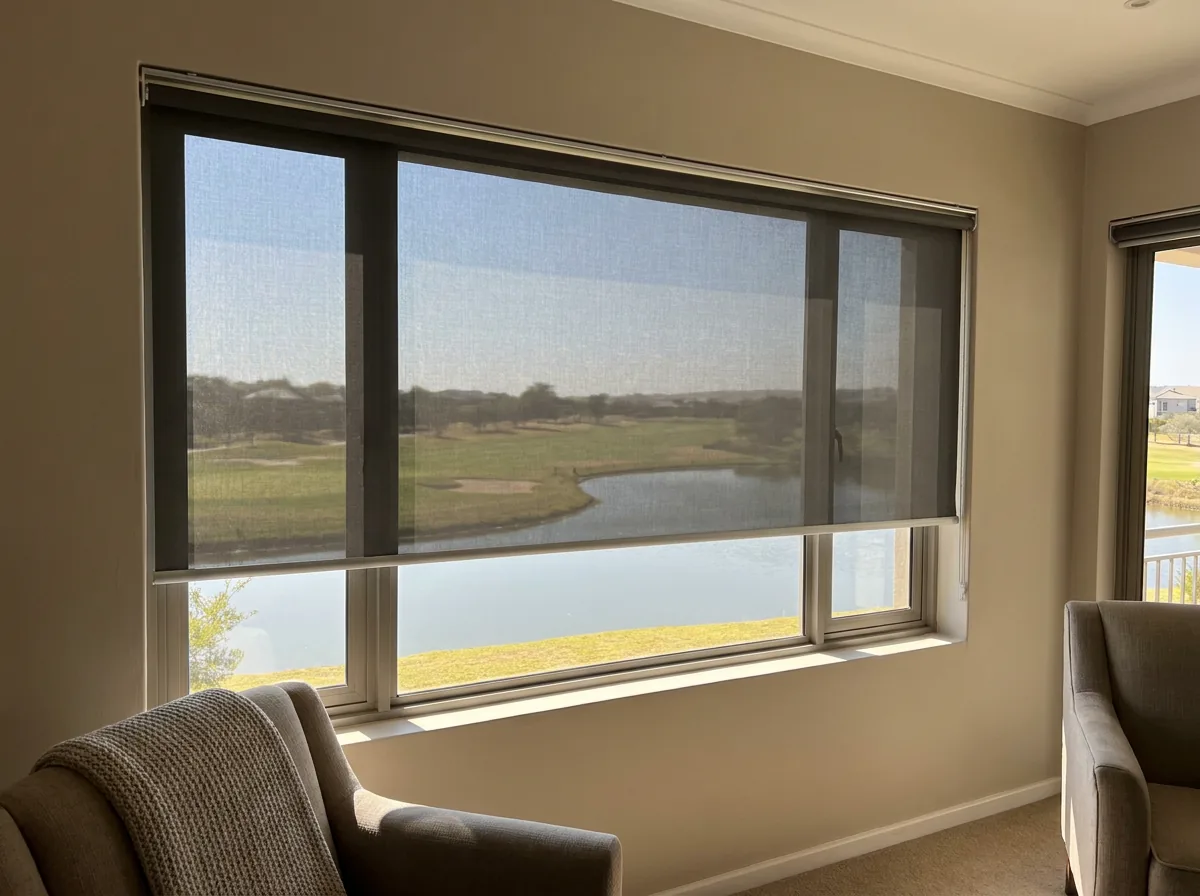
A smooth flat sunscreen mesh roller blind half-lowered over a large picture window in a Silver Lakes home, the golf fairway and lake still visible through the open-weave fabric

Best for fairway & lake view glass

Sunscreen roller blinds

Why here: a mesh with a stated openness (roughly 3–5% is the sweet spot for a big view window) cuts glare, heat and UV while you keep the reason you bought the house — the view stays visible through the weave.

The trade-off: it reduces glare, it doesn't erase it, and it gives daytime privacy that reverses after dark. For a room you also sleep in, it needs a blockout partner. It's the cheaper, lighter-touch move than exterior shading — but it manages heat inside the glass rather than stopping it outside.
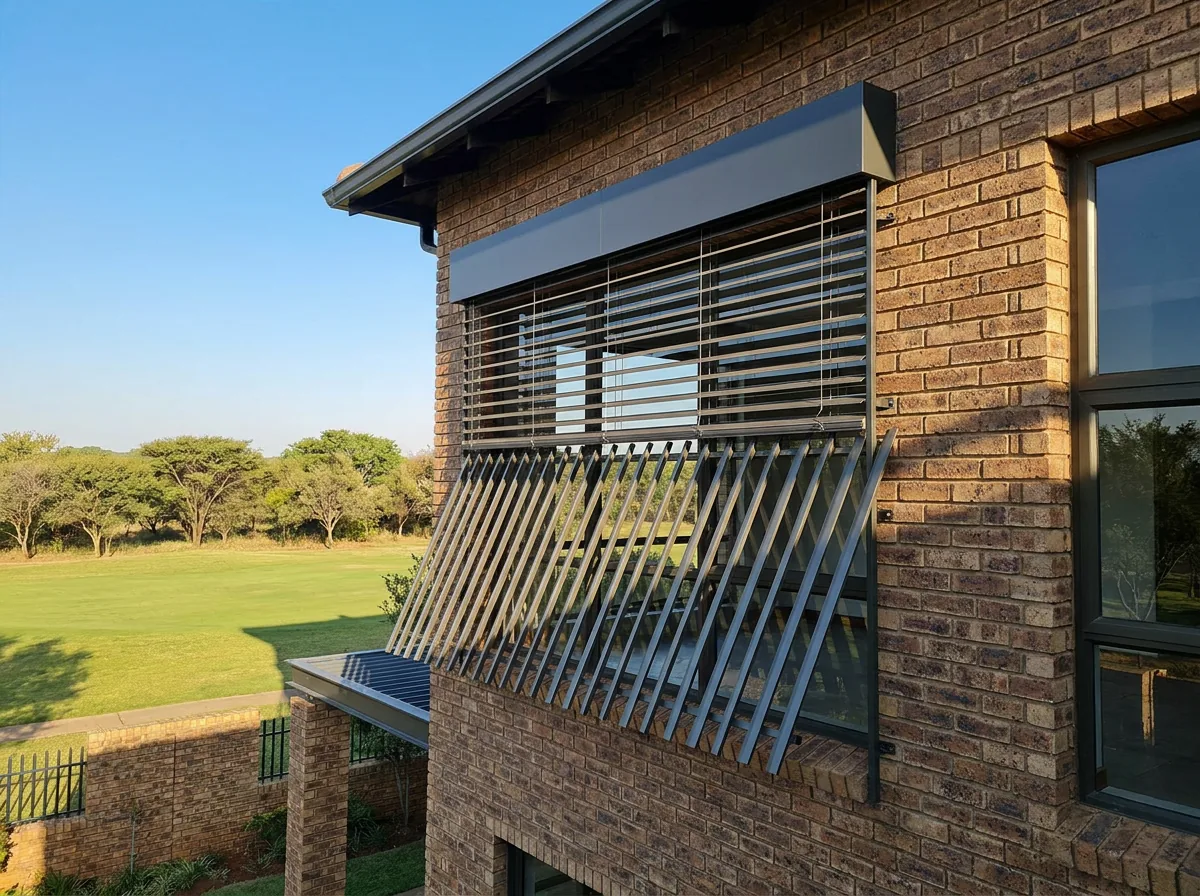
External aluminium venetian shading mounted on the outside of a west-facing window of a face-brick Silver Lakes home, thin metal slats tilted to intercept the low afternoon sun before it reaches the glass

Best for the west & hot entertainment wings

External venetian shading

Why here: on a west wall, stopping the sun outside the glass beats absorbing it inside. Tiltable external aluminium slats block the low afternoon load before it becomes heat in the room — the difference your air-conditioning notices in January. An interior blockout roller can darken the same window, but the pane still radiates the heat it soaked up.

The trade-off: it's the bigger investment and it's an exterior change, so it's an HOA-submittable item (see below). It's the strongest heat control there is; if the wall is west and the room is used, it usually pays its way.

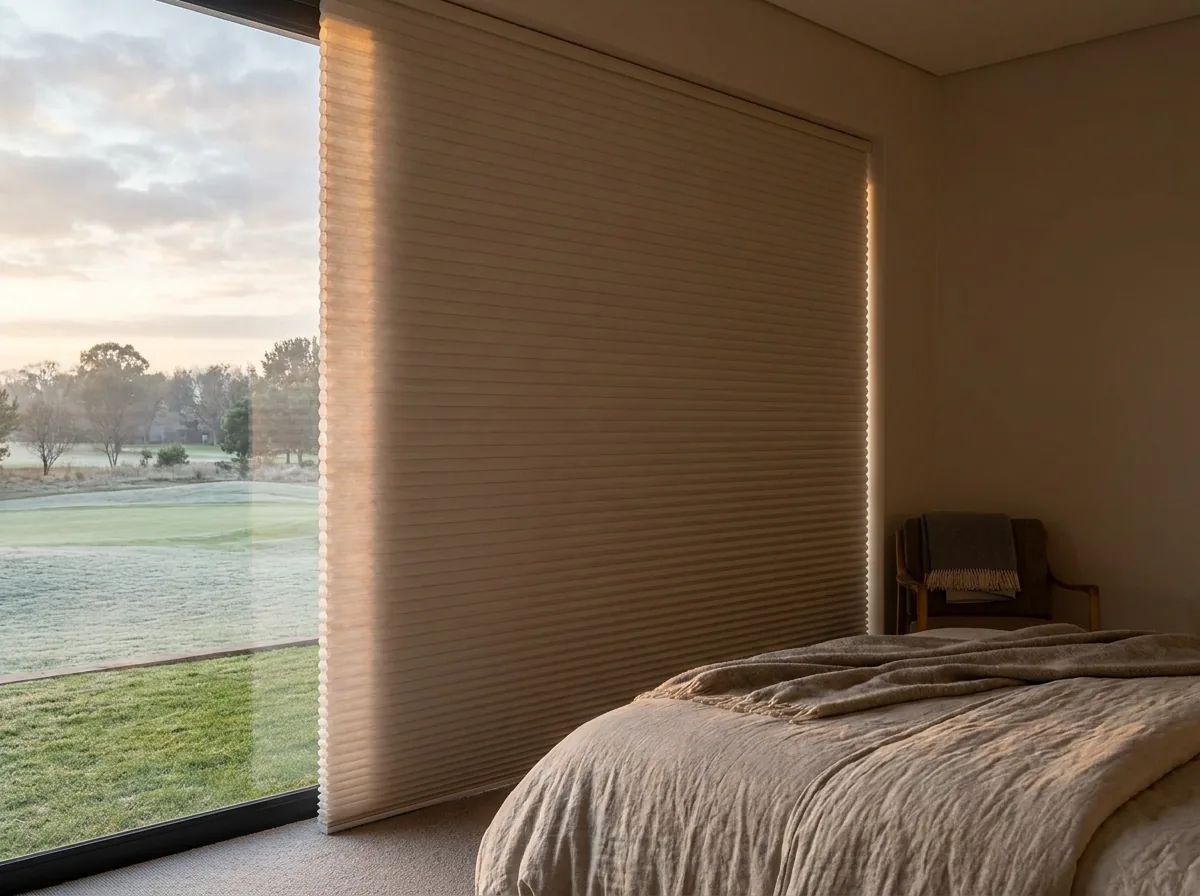
A cellular honeycomb blind lowered as a smooth flat panel over a bedroom window in a Silver Lakes home on a frosty Highveld winter morning, soft dawn light glowing at the edges

Best for bedrooms & cold-morning rooms

Cellular / honeycomb blinds

Why here: the honeycomb's trapped-air cells add real insulation, which matters on frosty Highveld winter mornings; in blackout fabric they also give a genuinely dark east-facing bedroom against that sharp sunrise. A plain blockout roller blacks out just as well and costs less.

The trade-off: you're paying for the insulation, not the darkness. Choose cellular where winter warmth and quiet matter; choose a blockout roller where you only need the room dark. Both belong on east-facing and bedroom glass, not on your main view window.

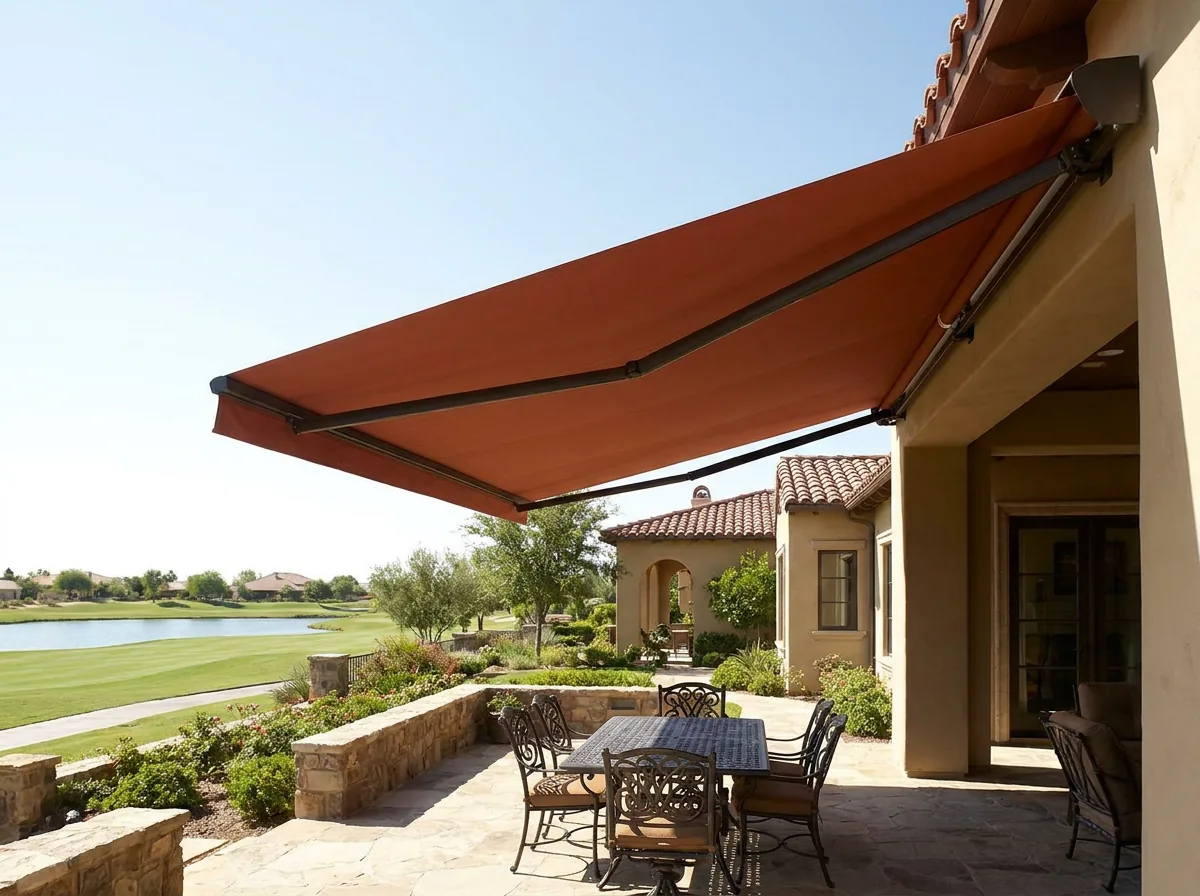
A folding-arm retractable awning extended over a paved entertainment patio of a Tuscan-style Silver Lakes home, shading outdoor furniture, with a golf fairway and lake beyond the garden

Best for patios & outdoor entertainment

Folding-arm awnings

Why here: the estate is built for outdoor living, and a folding-arm awning shades the patio itself — furniture, braai, people — on demand, then folds away to give the view and the winter sun back. A fixed pergola can't retract; this can.

The trade-off: it's fabric in the open on the Highveld, where summer storms and hail run October to December.[10] We'd add a wind sensor so it retracts before a storm rather than fighting it. Honest point: it's a comfort and shade product, not storm armour — bring it in when the sky turns.

Best for wide spans, high glass & multi-blind walls

Motorised blinds & automation

Why here: on a reachable window, a motor is a nice-to-have. On the wide sliders, stacked glass and multi-blind walls that define homes at Silver Lakes and Woodhill, it's the difference between blinds you actually use and blinds you fight. A sun timer drops the west wall at three whether you're home or not; a wind sensor pulls the awning in before the storm.

The trade-off: more cost, and it needs power routed to the right place — often the one thing we can only confirm on site. On a single small window it rarely earns its keep.

Best for verandas & multi-elevation rural glass

Roller shutters (shading)

Why here: rigid aluminium slats that roll down from a headbox on the outside of the glass, giving full external sun and glare control you can set anywhere from open to closed — useful on Mooikloof-style verandas and picture windows that catch sun on several sides.

The trade-off: a bolder look than a slim external screen, and it's an exterior change to submit. Said plainly: these are shading roller shutters, not security-rated shutters — a different product, available on request. We don't sell a shading shutter as home security.

05Estate & approval notes

Anything on the outside is an HOA conversation.

Silver Lakes runs architectural guidelines that reach roof pitch, external colours, fascia styles and boundary treatments, and the estate's own advice is to get plans to the HOA early to avoid redesigns and delays.[14] Interior blinds are your own business. But anything fixed to the outside of the home — external venetian shading, external screens, roller shutters, a folding-arm awning — is an exterior change an owner should expect to submit.

That's a step to plan for, not a hurdle. Well-specified exterior systems in clean profiles and estate-appropriate colours are approved routinely; the delays come from submitting late or without documentation. When we quote exterior work we hand you the product spec sheets to attach, and steer colour and profile toward what committees here accept.

06What a guide can't settle

What we'd still need to check on site.

Everything above gets you a confident shortlist. None of it is a quote, because five things change the answer and none can be judged from a page:

Exact reveal depthWhether a blind fits inside the reveal for the clean recessed look, or has to face-fix, depends on millimetres we measure — and it differs between your plastered and face-brick openings.
Existing fixings & lintelWhat's behind the plaster decides how an external system is anchored and whether a headbox clears the opening. It's the single most common on-site surprise.
Real wind exposureAn awning or external screen on an exposed western or Mooikloof elevation needs different bracing — and a wind sensor — from one tucked behind mature trees at older Silver Lakes.
Motor power routingAutomation is only as clean as the nearest power. Where a cable can run without chasing a finished wall is a site decision, not a catalogue one.
Fabric in your own lightOpenness and colour read completely differently against your actual fairway glare than in a brochure. Samples held up in the room settle it in a minute.

This is exactly what the free measure is for. It's a consultant, samples and a tape measure in your home — not a sales trap.

Two ways forward

Take what you've read straight into a quote.

Recommended

The free expert measure

A consultant comes to you with samples, measures every window precisely, checks the five things above, and leaves you a written, per-window quote. No charge, no obligation, no pressure calls.

Prefer a number first?

Send your own ballpark

Pop in rough sizes and the products you liked, and we'll send a budget range by the next working day. Not sure how to measure? Leave it — the free measure gives you exact per-window pricing instead.

Your ballpark, in about two minutes

Rough sizes in, budget range back.

Want a ballpark first? Add a row per window with rough width, drop and the product you liked, and we'll send a budget range by the next working day. Not sure how to measure? Leave it blank — our consultant measures for free and you'll get exact per-window pricing. The free measure below is the easier path if you'd rather we handle it.
Room Width (mm) Drop (mm) Fit Product
Windows on your list: 0

The close

Book your free expert measure.

One visit does most of it: samples in your own light, precise sizes, the five on-site checks settled, and a written per-window quote. Tell us where to call.

Our consultant does five to six measures a week across this area, so the diary fills early — booking ahead helps if you need a specific day.

We use these details only to arrange your consultation call-back (POPIA). No marketing lists, no sharing.

Thank you — a consultant will call you back shortly.

We'll be in touch to arrange your free in-home measure.

Where these facts come from

Sources

Every climate, sun-path and estate claim in this guide traces to one of these. Sun angles and UV are public science; estate detail is from published area and estate profiles.

  1. Sun position, azimuth & elevation for Pretoria — geotimedate.org
  2. Sun direction & daily path, Pretoria — sun-direction.com
  3. Solar angles for Pretoria — solarific.co
  4. Southern-Hemisphere sun-path illustrations (Brad Lancaster) — harvestingrainwater.com
  5. Sun, shade & daylight in SA town planning, Pretoria emphasis — SciELO
  6. Solar UV, altitude & skin-cancer strategies in South Africa (Wright, 2023) — Wiley; UV index by SA site — PMC
  7. Summer/winter solstice sun map for Pretoria (noon elevation, sunrise/sunset azimuth) — geotimedate.org
  8. Silver Lakes estate history, architecture & orientation — Estate Living; RealNet; Wikipedia
  9. Gauteng climate & weather overview — SA-Venues
  10. Highveld thunderstorm & hail season (Oct–Dec peak) — The Citizen; the science behind hail — University of Pretoria
  11. Silver Lakes architectural guidelines & submitting plans early — Estate Living